Essential Cookware for Small Kitchens: Sets vs. Individual Pieces
Author: Our Place | June 10, 2026 | Time to read: 4 min

In a small kitchen, space is the real ingredient. You can work around a missing spice or substitute a pan size, but you cannot manufacture a cabinet that does not exist. If you have found yourself stacking pans on top of pans, wrestling lids out of a packed drawer, or avoiding cooking altogether because your kitchen feels like a puzzle, this guide is for you.
Most advice frames this as a binary choice: buy a cookware set or build your collection one piece at a time. But for small kitchens, there is a more useful question to ask first: are you buying the right size cookware for how you actually live?
Sets vs. Individual Pieces
Cookware sets have real advantages. You get a coordinated collection, usually at a lower per-piece cost than buying individually, and everything is designed to work together. A well-chosen set can cover most everyday cooking without the guesswork of building piece by piece.
The downside? Most sets are designed for households cooking for four or more. A 12-piece set often includes a large stockpot you will rarely use, two saucepans of near-identical sizes, and a skillet that barely fits on a standard stovetop burner. In a small kitchen, unused pieces do not just take up space, they make the pieces you actually use harder to reach.
Building your collection piece by piece gives you more control. You invest in exactly what you cook with and skip the rest. The trade-off is cost: individual pieces typically run higher per item, and curating a complete collection takes time.
Both approaches can work well. But neither one fully solves the core challenge most small-kitchen cooks face, and that challenge is not really about sets versus individual pieces at all.
The Real Problem: Standard Cookware Was Not Built for Small Kitchens
Most cookware is engineered for households of four to six people. A 12-inch skillet and a 6-quart pot are outstanding tools, for the kitchen they were designed for. In a studio apartment or galley kitchen, they can be genuinely impractical, both in storage and in actual use.
If you regularly cook for one or two people, a large skillet often means using more oil, more stovetop space, and more heat than the recipe needs. Smaller portions spread across a big surface cook unevenly, dry out faster, and can stick in ways they simply would not in a right-sized pan.
The better question is not sets versus individual pieces. It is: does this cookware actually fit how I cook? Smaller-format pans, purpose-built in the 8-inch and under range, behave differently. Food sits closer together, moisture is retained better for small-batch cooking, and the pans themselves take up a fraction of the cabinet or drawer space of their full-size counterparts.
Cookware Built for Small-Space Living
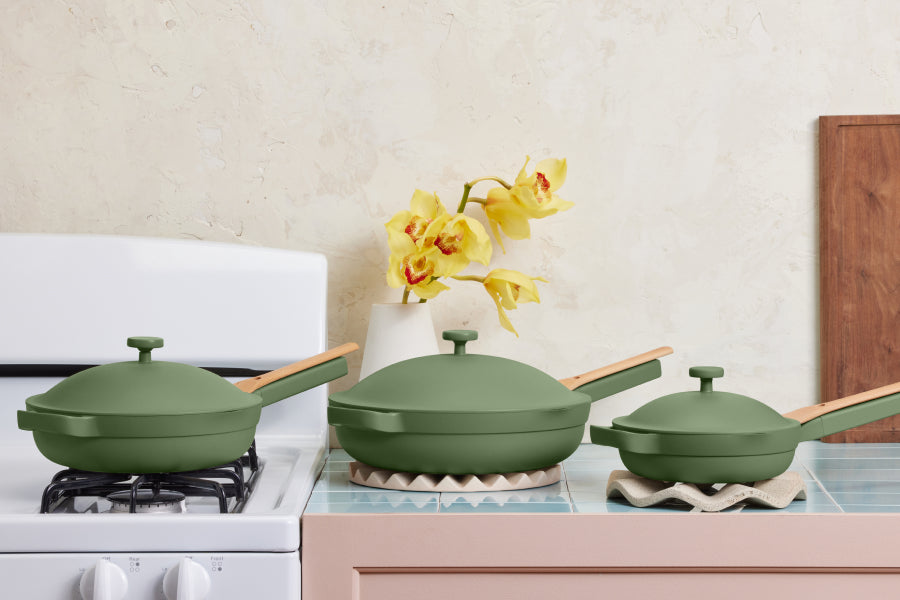
Purpose-built small-format cookware has started to take seriously what most cookware sets ignore. The Mini Always Pan is a compact version of the versatile Always Pan, built with the same Thermakind® ceramic nonstick coating and multifunctional design, sized for the reality of cooking for one or two. If you regularly make eggs, quick sautés, or single-serve sauces, a pan like this can replace several pieces you would otherwise be storing.
For those setting up a small kitchen from scratch, the Tinis Cookware Duo pairs two compact pieces that cover the core cooking functions, frying and saucing, in a form factor that actually fits. Rather than buying a full set stored in stacks, you get two thoughtfully sized pieces that work together for real, everyday cooking.
The approach here is not about buying less and making do. It is about buying the right size for your actual cooking, which often means you end up needing fewer pieces altogether.
💡Pro Tip
Nonstick cookware in smaller formats is especially practical for small kitchens: lighter to handle, quicker to clean, and proportioned for real-life portions.
What a Small Kitchen Actually Needs
There is no universal answer, but here is a practical framework for most small-kitchen cooks:
A compact nonstick pan (8 inches or smaller) for eggs, vegetables, and delicate proteins.
A small saucepan in the 1.5 to 2-quart range for sauces, grains, and reheating.
One versatile larger piece if your cooking calls for it, a small Dutch oven or deep skillet that works on the stovetop and in the oven covers a lot of ground.
If you occasionally cook for more people, consider adding one larger piece rather than a full set. A 10- or 11-inch skillet handles most recipes for four and is a single item to store.
One of the most useful habits in a small kitchen: before adding any new pan, ask what it replaces. Multifunctional cookware, pieces that move from stovetop to oven, handle eggs and proteins, steam and sauté, earns its place in a small kitchen far more reliably than single-use tools.
Storage Strategies That Actually Work
Even right-sized cookware needs thoughtful storage. A few approaches worth considering:
A vertical pot rack or wall-mounted rail keeps frequently used pieces accessible without eating into cabinet space. Hanging pans takes some commitment to install, but it is one of the most efficient small-kitchen solutions available.
Stack pans with soft cloths or pan protectors between them to protect nonstick surfaces, especially important for ceramic coatings.
Lids are often the bigger storage challenge. A drawer lid organizer, a mounted rail, or a repurposed file holder all keep lids accessible without creating a pile.
The goal is a kitchen where what you reach for most is always within easy reach, and what you do not use simply does not take up room.
The Bottom Line
The sets-versus-individual-pieces debate is worth having, but in a small kitchen, it is secondary to the size question. Buy cookware that fits how you actually cook, for the number of people you are actually cooking for. Whether that is a thoughtfully chosen set of compact pieces or a few individually selected pans, the goal is the same: a kitchen where everything earns its place.
A small kitchen can be one of the most efficient cooking spaces around, when it is stocked with the right tools.